
The rationalisation of goods and services tax (GST), announced on Wednesday, directly lowers the cost of everyday medical consumables, and also high-end therapies in oncology and rare diseases, helping reduce out-of-pocket patient expenditure and better adherence to medication.

'If you look at where inflation (headline and core) is today in India and where the rates are, there's clearly room to cut rates.'

For kids in the United States, the tariff imposed by the Donald Trump administration on countries like China may no longer be a child's play, as toy prices are predicted to touch record highs this Christmas season. However, for India's toy export industry, which was ready to take giant strides in the sector by bagging heavy orders from the US retail giants like Walmart, Amazon, and Target Corporation, gaining from the China-Plus-One policy, the US tariffs came as a heavy jolt.

In a move that could have implications for market share dynamics, the Securities and Exchange Board of India (Sebi) has permitted the National Stock Exchange (NSE) and the BSE to alter the days for settlement of equity derivatives contracts.

From the 30-share Sensex firms, Tata Motors, Bajaj Finance, Eternal, Adani Ports, Tata Steel, Titan, Mahindra & Mahindra and Power Grid were among the gainers. Asian Paints, Sun Pharma, ITC, Nestle, Reliance Industries and HCL Tech were among the laggards.

Markets consolidated in late trades to end lower as investors booked profits after the benchmark indices ended at their all-time closing highs yesterday.

The fear of losing purchasing power due to inflation and low-interest rates has led many to explore safe alternatives to fixed deposits with high returns

Shares of Hyundai Motor India Ltd, the Indian arm of South Korean automaker Hyundai, on Tuesday made a muted market debut and further fell by nearly 6 per cent against the issue price of Rs 1,960. The stock listed at Rs 1,931, reflecting a decline of 1.47 per cent from the issue price on the BSE. Later, the stock made some recovery and hit a high of Rs 1,968.80, up 0.44 per cent.

Benchmark equity indices Sensex and Nifty ended lower on Monday after hitting their all-time high levels in early trade amid selling in blue-chip IT stocks and HDFC Bank. After breaching the 77,000-mark during the early trade, the 30-share BSE Sensex came under selling pressure at the fag-end of the session and ended 203.28 points or 0.27 per cent lower at 76,490.08. During the day, the benchmark jumped 385.68 points or 0.50 per cent to hit a new record of 77,079.04.
India's real GDP growth in FY26 will slide further to 6.2 per cent in FY26 from 6.5 per cent in FY25, a Japanese brokerage said on Monday. In a research report, Nomura said there is a "divergence" between the growth in GST collections and across other high-frequency growth indicators like auto sales and bank credit growth.

An average Indian couple spends around 2x on weddings versus education (pre-primary to graduation).

While the economy will wait for a rate cut in December, the banking industry should be happy with the wave of liberalisation -- a big push for growth in bank credit, points out Tamal Bandyopadhyay.

From the 30-share blue-chip pack, Zomato cracked nearly 7 per cent. Power Grid, Adani Ports, Tata Steel, NTPC, Tata Motors, Tech Mahindra, Mahindra & Mahindra, Asian Paints, Sun Pharma and UltraTech Cement were the other major laggards. In contrast, Axis Bank, Hindustan Unilever, Tata Consultancy Services and IndusInd Bank were the gainers.

A host of macroeconomic data announcements, the last batch of September quarter earnings, global trends, and trading activity of foreign investors will be the major driving factors for the equity market this week, according to analysts. Equity markets would remain closed on Friday for Guru Nanak Jayanti. "India is set to release CPI and IIP data on November 12, with WPI data expected on November 14.

Equity benchmark Sensex on Thursday plunged about 965 points to crash below the 80,000 level due to heavy selling in global equities after the US Federal Reserve signalled fewer rate cuts next year. Besides, deep losses in consumer durables, banking and IT stocks amid foreign fund outflows added to the gloom, analysts said.

Stock markets will focus on global trends for further direction in this holiday-shortened week as the earnings season is largely over, analysts said. Trade experts expect the key benchmark indices to move sideways as investors are trying to decode the impact of rising inflation on foreign portfolio investments. Inflation data released by the US and China last week have fanned fears of earlier than expected rate hike and boosted US bond yields.

From the Sensex firms, Hindustan Unilever, Kotak Mahindra Bank, Trent, Reliance Industries, Asian Paints and ITC were among the gainers. However, Bharat Electronics Ltd, Tech Mahindra, UltraTech Cement, Maruti and Eternal were among the laggards.

The share of Ahmedabad in the total value of trades on both the BSE and NSE is set to touch double digits for the third year in a row.

Last fortnight, State Bank of India Chairman C S Setty lifted the veil on a subject long spoken of in corporate corridors: Why can't our banks finance mergers and acquisitions (M&As)? Change is in the air: Indian Banks' Association (of which Setty is the chairman) is to "make a formal request" to Mint Road to make way for it. Thus far the exclusive turf of foreign banks even though its funding remains offshore - as in, it's not on these entities rupee-book (and a few select shadow banks) - a most lucrative segment in the investment banking suite, M&As, will be homeward-bound.

Quarterly earnings from corporates, global trends, and trading activity of foreign investors will guide market sentiment this week, analysts said, adding that benchmark indices may face volatile trends. "The upcoming release of Q2 results will be closely watched, providing insights into corporate performance. "Meanwhile, the escalating tensions between Israel and Iran introduce a significant geopolitical risk, potentially leading to increased oil prices and market volatility.

Equity benchmark indices Sensex and Nifty settled lower for the sixth straight session on Monday due to heavy selling in bellwether stocks including HDFC Bank and Reliance Industries amid mixed trends in the global markets and outflow of foreign funds. Falling for the sixth consecutive session, the BSE Sensex tumbled 638.45 points or 0.78 per cent to settle at 81,050. During the day, it plummeted 962.39 points or 1.17 per cent to 80,726.06. The NSE Nifty slumped 218.85 points or 0.87 per cent to end at 24,795.75.

Among Sensex firms, Asian Paints, Bajaj Finance, Tata Steel, Bajaj Finserv, ICICI Bank, Maruti, Reliance Industries, HDFC Bank and Mahindra & Mahindra declined. Tech Mahindra, Tata Motors, Infosys, HCL Tech, IndusInd Bank and UltraTech Cement were among the gainers.

Have the markets already played out their dynamics before the economy has even properly taken off? Are we now destined for a period of mediocre returns despite a strong economy? asks Akash Prakash.
Investor wealth eroded by Rs 4.46 lakh crore in a single day on Friday with the benchmark BSE Sensex tanking more than 1 per cent in line with global stocks rout. The 30-share BSE Sensex plunged 885.60 points or 1.08 per cent to close at 80,981.95 with 25 of its components declining and five ending with gains. During the day, it nosedived 998.64 points or 1.21 per cent to hit an intra-day low of 80,868.91.

Some of the key names include: Maruti, M&M, Ashok Leyland, Britannia, Ultratech, JK Cement, Havells, Voltas, Amber, Metro, Trent, LemonTree, Indian Hotels, Niva Bupa, HDFC Life, IGL, Acme Solar, Suzlon, Swiggy, Delhivery, ICICI Bank, HDFC Bank, Bajaj Finance, Shriram Finance," according to a report by Motilal Oswal Financial Services.

From the Sensex constituents, Tata Steel, Bajaj Finance, Bharti Airtel, Adani Ports, Eternal, Bajaj Finserv, NTPC, HDFC Bank, Reliance Industries and Axis Bank were among the major gainers. In contrast, Trent, State Bank of India, Tech Mahindra, Maruti and Mahindra & Mahindra were among the laggards.

The other prominent gainers were Tech Mahindra, HCL Technologies, Wipro, State Bank of India and Larsen & Toubro. Bajaj Finserv, Power Grid, UltraTech Cement and HDFC Bank were among the laggards.

The market could be influenced by events elsewhere in the world and regardless of what happens to India's economy

Equity benchmarks Sensex and Nifty gave up early gains to close in the red on Wednesday after a selloff in power, metal and consumer durable stocks amid a weak trend in global equities. However, a rally in the rupee against the US dollar and unabated foreign capital inflows helped the indices restrict the losses, traders said. In a largely range-bound session, the 30-share BSE Sensex ended 151.60 points or 0.25 per cent lower at 61,033.55.

After a prolonged winter, the Indian edtech sector seems to be witnessing some signs of a thaw. The sector has received $608.8 million of funding across 68 deals in 2024 so far - 153 per cent more than the $240.9 million across 106 deals during the same period last year - according to data from market intelligence platform Tracxn.

'If weak indicators persist, there is a risk that India could slip into a prolonged slowdown similar to the one experienced between 2014 and 2019,' warns Debashis Basu.
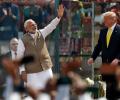
'It's important for India to think about areas where it wants the US to move.' 'We can be far more innovative in what we ask the US.' 'Given that there's a package deal, why not do it?'

'It's the second-largest market for us after the US, and should be the largest market at some point.'

Reliance holds 67.03% of Jio Platforms Limited and the public listing would provide an exit to many investors.

Analysts are warning of growing risks to the market's sustained momentum, and even to the possibility of consolidation at current levels. Domestically, markets are grappling with several challenges, including a slowing economy, as indicated by the latest GDP data for the July-September (Q2) quarter of 2024-25 (FY25), sticky inflation, fluctuations in the rupee, waning consumption, and high interest rates.

'India's fundamentals are a lot better (than those of other emerging market economies).' 'India will suffer (witness a fall in its stock market) what I call the second order effect.' 'And the second order will happen when these funds (belonging to macro and hedge fund investors and which have leveraged Japanese yen-carry trades), because they lose money elsewhere as lot of their positions were financed by borrowing Japanese yen, will have to book profits in investment destinations where they are making money, including in markets like India.' 'They (these investors) will have to effectively sell in countries like India and which is the consequence (the crash in equity markets) that Indian markets might see.'
As many as 267 of 453 companies from the BSE500 index are trading above their consensus price targets, according to the data compiled by Bloomberg. Not all companies in the BSE500 index are tracked by analysts.

The Reserve Bank of India's (RBI) Monetary Policy Committee's (MPC) decision to cut the repo rate by 50 basis points (bps) to 5.5% was contrary to the expectations of many economists. Firstly, most of the economists expected the MPC to cut the repo rate by 25 bps citing the weakening of inflation, prospects of economic growth, geopolitical uncertainty and comfortable system liquidity.

A sharp fall in the equity market made investors poorer by Rs 5.29 lakh crore on Tuesday when the BSE benchmark Sensex tumbled over 800 points. A host of negative triggers -- muted quarterly earnings, continuous foreign fund outflows and weak trends in Asian and European markets -- dragged the benchmark indices lower. The BSE benchmark gauge tumbled 820.97 points or 1.03 per cent to settle at 78,675.18.

Small stocks of Dalal Street grappled with turbulent times in 2022 as high volatility and higher interest rate regime sapped investors' appetite for these scrips but the horizon ahead seems less cloudy for the New Year. While the 30-share Sensex scaled multiple record peaks with bluechips glittering, small stocks underperformed and the BSE smallcap index declined more than 3 per cent this year. In comparison, the BSE Sensex climbed 2,673.61 points or 4.58 per cent till December 27.
